Ebola in DR Congo: on the frontline, but last in line for funding

Caritas International Belgium Ebola in DR Congo: on the frontline, but last in line for funding

© Tommy Trenchard - Caritas Internationalis

© Tommy Trenchard - Caritas Internationalis

02/09/2026

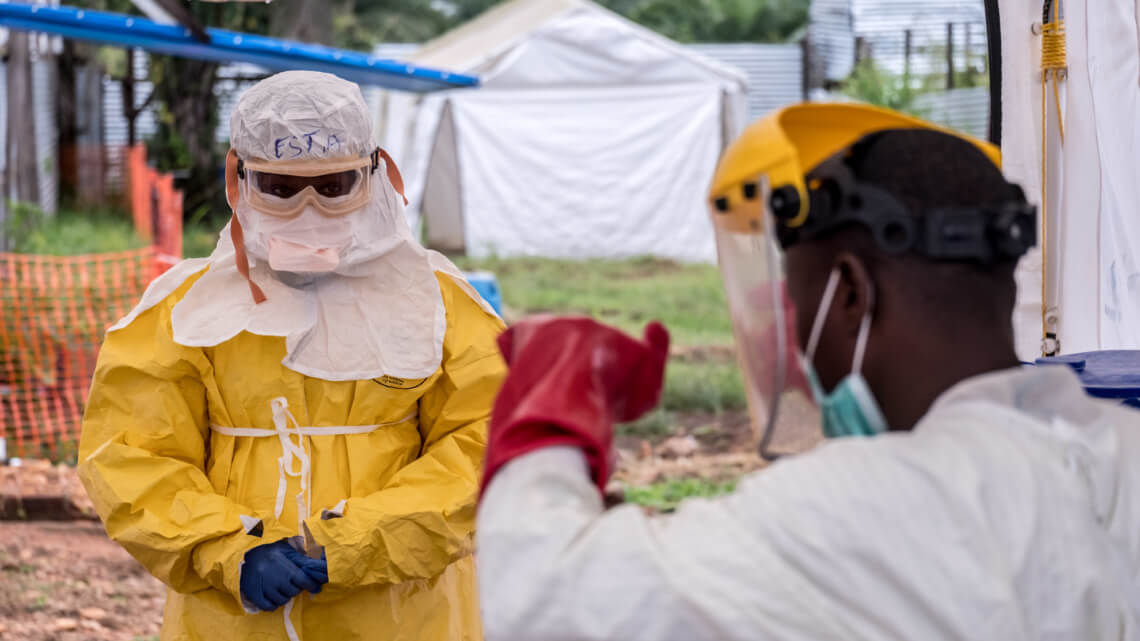
A new Ebola outbreak has been declared in the Democratic Republic of the Congo, the country’s seventeenth. As with every resurgence, the international response swings into action: alerts are issued, missions are deployed and emergency funding is released. Yet on the ground, Congolese parishes, community workers and NGOs are the first to respond. Despite this, the share of funding entrusted to them continues to shrink year after year.

Present before the spotlight turns their way

The new Ebola outbreak continues to spread rapidly. As of 24 August, 5,665 confirmed cases and 2,700 deaths had been recorded. In less than a month, cases had risen by more than 80% and deaths by 95%.

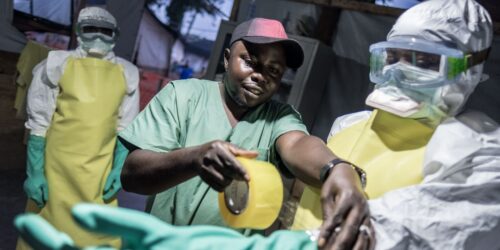
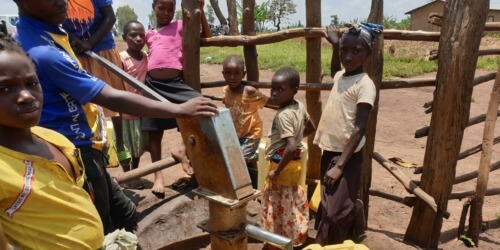
In Bunia, in Ituri – the epicentre of the outbreak and one of the worst-affected provinces – the local Caritas distributed WASH kits for water, sanitation and hygiene, as well as infection prevention and control supplies, to frontline health facilities.

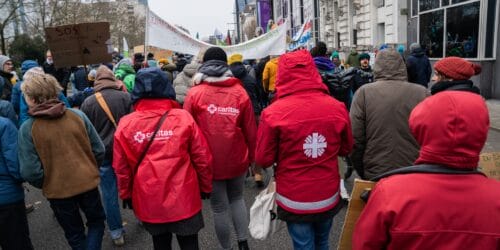
In Goma, the diocesan Caritas organised a large mobile awareness campaign at the end of June. Dozens of motorcyclists travelled through the city’s neighbourhoods, markets and outskirts, broadcasting radio spots, educational songs and prevention messages delivered by performers. The aim was to counter misinformation and remind people of life-saving measures, including at the drinking-water supply points managed by the organisation.

Across the border in Uganda, Caritas Kasese and Caritas Nebbi raised awareness among local communities and supplied schools, churches and mosques in the two border districts with soap, handwashing stations, sanitiser and face masks. Because of their proximity to Ituri, these districts are considered particularly vulnerable to transmission from eastern DR Congo.


Caritas International Belgium Ebola in DR Congo: on the frontline, but last in line for funding

© Caritas Goma

Trois réponses, trois régions, un même constat : ils et elles ne sont pas seulement les premiers et premières témoins de l’épidémie, mais celles et ceux qui interviennent en tête. Dès le déclenchement d’une alerte sanitaire, lorsque les équipes internationales ne sont pas encore déployées, ce sont les centres de santé, les relais communautaires, les paroisses, et les ONGs locales qui informent, rassurent et protègent les populations.

Their work also begins long before an emergency erupts. Humanitarian funding makes it possible to respond once an outbreak occurs. Longer-term funding keeps health services, surveillance systems and access to water operational. Yet this funding has fallen sharply since 2025, weakening local prevention and early-detection systems. In Ituri, several community-based surveillance programmes were suspended, contributing to delays in detecting the outbreak.

The problem is therefore twofold: cuts to development funding fuel new humanitarian needs, while the humanitarian funding subsequently mobilised still largely fails to reach local organisations.

This reality is now openly acknowledged. In August, amid the response to the outbreak, Dr Jean Kaseya, Director-General of the Africa Centres for Disease Control and Prevention, admitted: “This is the mistake we have made since the beginning of this outbreak: we did not listen to communities. The Ebola response can no longer be exclusively medical. It must be led at village level and built on community engagement.”

Caritas International Belgium Ebola in DR Congo: on the frontline, but last in line for funding

The organisations receiving the least funding from the humanitarian system are often the very ones on which the success or failure of the response depends.

Christian Nsangamina, Humanitarian Coordinator at Caritas Congo

Funding is increasing, but promises are not being kept

Following a contribution of $370 million from the United States government, the UN-managed humanitarian pooled funds available in DR Congo have increased eightfold this year. On paper, this is welcome news. In practice, one figure captures the gap between rhetoric and reality: the share of these funds reaching local organisations directly fell from more than 60% in 2025 to less than 5% in 2026.

In other words, the organisations that are first to support affected communities now receive only a fraction of the resources mobilised in those communities’ name.

CONAFOHD brings together forums of Congolese humanitarian and development NGOs, including local Caritas organisations, and has strongly criticised this trend. According to the network, the principle of “localisation” has been hollowed out, as though large grants should automatically go to international organisations while local actors are expected to settle for what remains.

Part of the problem lies in the route the money takes. Funding first passes through UN agencies and then through international NGOs, which rely on local partners to implement activities. At every stage, a share is absorbed by management costs before the funds ever reach the field.

Less support and less influence for local actors

Local actors are not only underfunded; they are also largely excluded from decision-making. Congolese NGOs have criticised consultation processes that give them little say in decisions directly affecting their own communities. The more the humanitarian sector speaks about “localisation”, the starker the contrast becomes: those closest to a crisis often remain furthest from the places where decisions are made.

For Caritas International and its Congolese partners, the issue extends far beyond the Ebola response. What is at stake is the humanitarian system’s ability to deliver on its own promises. Three priorities stand out:

  • Provide direct funding to local actors, in keeping with the spirit of the Grand Bargain. The capacity of national NGOs should be strengthened and mobilised first, before the remaining resources are entrusted to international organisations – not the other way around.
  • Set and meet measurable funding commitments. CONAFOHD is calling for a significantly larger share of humanitarian funding to be made directly accessible to national NGOs.
  • Move beyond the reflex of responding only to highly visible emergencies, by investing meaningfully in long-term prevention and bringing greater attention to forgotten crises.

Ebola is spreading again, and the same questions are returning: how are decisions made about where attention and money go, and whose voices count? As long as local actors are informed rather than genuinely involved, and receive crumbs rather than trust and resources, “localisation” will remain little more than another term in policy reports. The humanitarian system will continue treating symptoms instead of addressing their underlying causes.

In Bunia, Goma and Kasese, Caritas teams cannot wait for this debate to be resolved. With the resources available to them, they distribute essential supplies, travel through neighbourhoods and train community workers.

Caritas International is calling for greater transparency around funding criteria, more direct resources for local actors and a full role for Congolese organisations in decisions affecting their own communities – in the Ebola response and in every crisis, whether visible or forgotten.

“Those who detect crises first should not be the last to receive the resources needed to respond,” Christian Nsangamina concludes.

Linked news

All the news